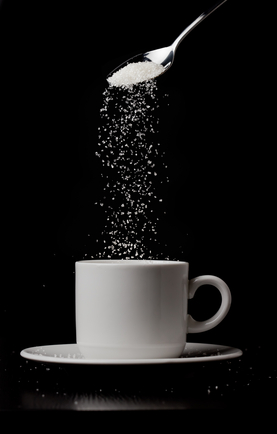
 I was watching “Hungry for Change” this weekend, and it was validating to hear other health experts say what I’ve been saying for a while: sugar is as addictive as cocaine or heroin.
Seriously, it’s one of the hardest things in my work as a health coach: to get people off of sugar. People are like, “Nuh uh, you stay away from my sweets and my chocolate and my bread!” Bread is glycemically equivalent to sugar, so a bread addiction is a sugar addiction, as well.
We all (I hope) know that sugar consumption leads to our obesity problem, but it also is a major contributor to chronic diseases and conditions because it is extremely inflammatory (oxidative) within the body.
Even if people know this, there’s definitely a cognitive dissonance when it comes to sugar, probably because of its addictive nature. I’m always astounded at the amount of sugary foods on display at school parties and PTA functions.
I’m not saying I never indulge, but it’s an occasional treat, not a daily or a many-times-a-day thing. I’ve discovered through years of being hypoglycemic (at least since a teenager) how to manage my sugar cravings so they’re not controlling me and my emotional reactions. Plus, I don’t want to become a type 2 diabetic like my mom was or my other family members are.
I can always tell when something I’ve eaten has sugar in it because I get very agitated and antsy – what does this do to our kids?
Chef Jamie Oliver makes an excellent visual point by dumping out a wheelbarrow full of sugar on a TED stage to demonstrate the amount of sugar that a child gets from just flavored milk in a 5-year period. How much sugar do you or your children eat every day?
 You’ve heard it before: everybody is super-stressed these days. Personally, I think a lot of it has to do with technology creep into our daily lives.
 “A growing body of research suggests that sugar and its nearly chemically identical cousin, HFCS, may very well cause diseases that kill hundreds of thousands of Americans every year, and that these chronic conditions would be far less prevalent if we significantly dialed back our consumption of added sugars.
 Recovery from autism is possible. Most, if not all, cases have gut dysbiosis, which is fed by the Standard American Diet (SAD) full of sugar and processed foods.
 Anyone who’s spent time with a cranky child – or adult – after they’ve eaten too much candy can tell you: